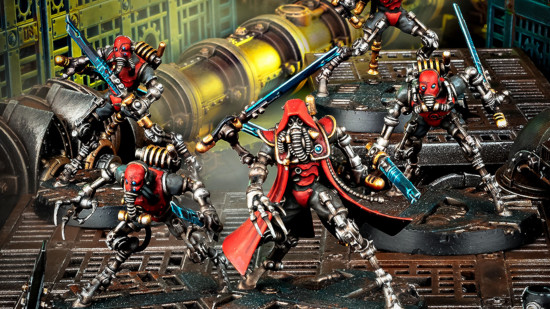
I started playing the Adeptus Mechanicus in 10th edition, so I don’t know how the faction has fared in previous editions – but – it’s been pretty rough so far.
The Codex dropped very early in the edition, and it was absolute garbage. It was very obvious that they hadn’t fully adapted to writing rules for 10th edition yet and were very conservative with flavour, strength, and literally any sense of a cohesive army. You can see the difference when current indexes get a new codex, it’s almost an entire army re-write.
From what I’ve read of people complaining on discord and reddit, Ad Mech has traditionally been an army that’s rules are written poorly – like this blog – and comprises of two different armies in one (sort of), cult mechanicus and Skitarii. This is reflected in two of the detachments, Skitarii Hunter Cohort (SHC), and Data-Psalm Conclave. There is also Rad-Zone Corps, the index detachment, Explorator Maniple, which we don’t talk about, Cohort Cybernetica, which is more viable now Kastelan Robots have the army rule, and now Haloscreed Battle Clade (HBC), which in my opinion is the best detachment to play in this army hands down.
While SHC may still be the ‘strongest’ way to field the army, it’s a bullshit way to play the game and in my opinion not sustainable long term. Across 6 game GTs you go to time every round, have an insane number of activations and are in a constant state of stress. The mental degradation of playing armies like this confounds the ability to perform, and as a result I believe HBC will provide more consistent results and a more enjoyable tournament, and casual game experience.
Detachment Overview
While the previous detachments each focus on a specific section of the army, i.e. SHC – Skitarii, Cohort Cybernetica – Vehicles, DPC – Cult Mechanicus, Explorator Maniple – Literally nothing lmao, this detachment is key-word agnostic, encouraging an all-comers approach. Similarly to Rad-Zone Cohort, the detachment does not make you feel like you’re missing out for not bringing certain models or combinations. The possibilities for list building are endless, and you really can brew a lot of different winning combinations if you’re inclined to actually make your own lists and think critically.
Detachment rule: Noospheric Transference
In your command phase, choose a number of units based on the battle size (1 for Incursion, 2 for Strike Force, 3 for Onslaught). They gain the HALO OVERRIDE keyword, you then choose a buff to apply to all HALO OVERRIDE units in your army until your next command phase. The buffs to choose from are:
- +2″ to move
- +1 toughness
- Advance and Charge
- Stealth
Additionally, it allows you to select units that are in transports, you must select an Adeptus Mechanicus unit, so no allied units.
This detachment ability is incredible and synergises well with the enhancements and stratagems. By having on-demand buffs, combined with flexible Doctrinas allows you to play the game, and be incredibly aggressive while doing so.
Enhancements:
- Transoracular Dyad Wafers (15 points): Cybernetica Datasmith model only, gives Kastelan Robots the Halo Override keyword. Now that Kastelan Robots have the army rule innately this is still strong, and would allow you to potentially place the detachment rule on 3 units of Kastelan Robots at once.
- Cognitive Reinforcement (35 points): Adeptus Mechanicus model only (Excluding Cybernetica Datasmith). Both Conqueror and Protector Imperative are active for the bearer’s unit. At 35 points it’s very pricey, but having +1 WS/BS, assault/heavy, extra ap and -1 to hit in melee on a unit for the entire game is incredibly strong, especially on a 6 strong Kataphron brick.
- Sanctified Ordnance (10 points): Adeptus Mechanicus model only. Add 6″ to the range characteristic of ranged weapons equipped by models in the bearer’s unit, and each time a Hazardous test is taken for that unit, you can re-roll the result. This is the perfect buff for a unit of Kataphron Destroyers with Plasma Culverins, but adding an extra 6″ threat range to any unit is incredibly effective, in some situations it may as well be move an extra 6″, very strong.
- Inloaded Lethality (15 points): Tech-Priest Dominus or Manipulus model only. +3 attacks and +1 damage to the bearer’s melee weapons. Giving your Tech-Priest a 7 attack, 3 damage weapon is unironically very strong for Ad Mech who can typically get tied up in combat. I have found great value from this enhancement for only 15 points.
The combination of Transoracular Dyad Wafers and giving Kastelan Robots either +2″ move, or advance and charge makes them a viable threat in this detachment. You could even give them Stealth, or get them up to T11, allowing them to sit on an objective and actually hold it for a few turns.
The other enhancements are just as solid, increasing the strength of any character unit you choose. I would happily run all of these enhancements, and if I wasn’t taking Kastelan Robots I would try to take all the other enhancements if I had the points available.
Stratagems:
The stratagems in this detachment are just unreal, there will be games where you use all 6 of them and they will be incredibly impactful (All of the stratagems cost1 CP).
- Eradication Protocols – Your shooting phase or the fight phase; one Adeptus Mechanicus unit from your army. Re-roll wound rolls of 1, and if the unit if a HALO OVERRIDE unit, re-roll hit rolls of 1. On demand re-rolls is excellent in an army that is anaemic for re-rolls outside of Skitarii Marshals and Kataphron Breachers. This stratagem is incredibly useful on a unit of Electro-Priests or Ruststalkers.
- Targeting Override – Your shooting phase or the Fight phase; one Adeptus Mechanicus unit gains Critical hits 5+. Crazy 5’s, the most fun ability in the game, effective on any unit being led by a Tech-Priest Manipulus, Corpuscarii, Ironstriders, Dragoons, Dune Crawlers with the funny gun etc.
- Neural Overload – Your movement phase; One Adeptus Mechanicus unit from your army, if your unit is a Halo Override unit, it suffers D3 mortal wounds. Select one Override ability, until the start of your next command phase, that ability is active for your unit. This means you can double up on Overrides on the same unit or select a different unit for a specific Override. The timing of this being in the movement phase allows you to test the waters and be incredibly flexible with your plays.
- Aggressive Impulse – Your movement phase; One Skorpius Dunerider that has not been selected to move, units that disembark from the model after it makes a normal move are still eligible to declare a charge this turn. Stacking this stratagem with +2 move on a Dunerider allows you to move 14″, disembark and charge. 17″ moving Corpuscarii or Fulgurites? Incredible. This allows you to be incredibly aggressive and fast with your plays.
- Guided Retreat – Your movement phase; gives shoot and charge after falling back; if it is a Halo Override unit, they can re-roll desperate escape tests. It is an odd combination of being able to re-roll desperate escape tests, as if the unit is battle-shocked you can’t use this stratagem on it anyway. I could see this units on a unit of Ruststalkers for example, that want to fall-back over the top of an enemy unit.
- Analytical Divination – Your opponent’s movement phase, just after an enemy unit ends a normal, advance or fall-back move; one Adeptus Mechanicus infantry unit within 9″ of that enemy unit and not within engagement range of enemy units can make a normal move or up to D6, or 6″ instead if that is a Halo Override unit. This allows you to move 6″, incredibly strong, or move and embark back into a transport.
This suite of stratagems is unreal and brought me back to playing Ad Mech late last year after I had given up (I don’t want to play SHC). Guided retreat alone makes this detachment worth playing, being able to avoid being bogged down and having access to shoot and charge afterwards is an amazing tool to have.
Playing the detachment
In my opinion the strongest asset this detachment has access to is movement. It doesn’t matter what units you take in this detachment, to an extent, because the ones you do will be able to get to where you need them, when you need them.
I spent a lot of time playing Data-Psalm Conclave and what I struggled with most was getting my units into their effective threat ranges and staging. HBC allows you to keep your units incredible safe while still threatening immense shooting and charging threat ranges.
Strengths
- Flexibility – there are truly no unviable units in this detachment.
- Incredible stratagems and enhancements, lacking the restrictions other detachments employ.
- Defensive, and offensive buffs available to all units (except reactive move is restricted to infantry).
Weaknesses
- You have to play Ad Mech.
All of this is relatively meaningless without a ‘why’.
Why should you play Haloscreed Battle Clade?
In 2010 I was at home playing RuneScape on my computer when my friends invited me to play a relatively new game called League of Legends. Shortly after I started playing, in April of 2011, a new character was released, Lee Sin. I loved playing Lee Sin, the use of energy instead of mana meant you were limited by cooldowns, meaning the decisions for which abilities you used and when you used them were incredibly impactful.
At the time, Lee Sin was mostly played in the Jungle, so typically, you would pick up a Hunter’s Machete, or if you were laning a Doran’s Shield or Sword. From here you would continue on with level 1 boots, then a tanky item like a Sunfire Aegis or Spirit Visage.
Nah man, not me. I wanted to go FAST. Lee Sin had the ability to dash to allied champions, a skill shot which propelled him towards enemy champions and an AOE slow. He was built to go. Although it was against the grain, I found a lot of success in rushing the not so popular item boots of swiftness. The speed allowed me to move around the map faster, even at the loss of durability and power it was incredibly effective. From here I would typically snow-ball into a Tri-force and dominate the early game putting the enemy team far behind.
How does this relate to 40k you may ask? I’m not sure, it’s just an old memory I wanted to share. But now I’ve gone fast with Ad Mech, I can’t go back. I wanted to try to run Explorator Maniple at a GT in a few weeks as a meme, but I can’t give up the extra movement.
I am fast as fuck boi, and I’m not going any slower.
To answer the question of why you should play Haloscreed Battle Clade?
If you enjoy taking the initiative, asking questions and dictating the pace of the battle then HBC is an excellent detachment. That doesn’t necessarily mean you need to or should play it this way. It’s just one way to play it.
You can absolutely play Ad Mech swarm style, move blocking with Pteraxii and Infiltrators while shelling the shit out of your opponent with Disintegrators, Dunnies, and Chickens. But the real fun of the detachment involves moving a Dunerider 14″ forward, disembarking a melee unit and charging at your opponent.
Why should you listen to me? I don’t really care, someone in Discord is going to tell me I’m wrong anyway.

Behold, my greatest achievement (achieved at Rataclysm 2024). If this doesn’t convince you I’m worth listening to, I don’t know what will.
Now that we’ve identified the major strength of this detachment, lets discuss how we can abuse it.
Moving fast is not just for melee units
I was listening to an Art of War 40k podcast recently where the guest was discussing his experience with playing Shadow Legion, and going undefeated at a GT.
They were discussing their experiments with list-building prior to the event and corroborating with teammates. After thorough Meta-analysis and math hammer, they were convinced, absolutely convinced, that 15 Havocs with Las cannons protected by Be’lakor’s no shoot 18″ aura were incredibly strong. However, when they put them on the table – as any good CSM player who has used Havocs would know – they were dogshit.
That is to ask the question, what is a good unit?
As sure as a new datasheet is released, there will be undesirables online spreading misinformation about the strength – or lack of – said particular unit. Typically, these hot takes are incorrect. Even within the game, well known units can occasionally ‘pop off’ and go hot. Take the Vindicator for example, a unit that I’ve seen one-hit Magnus the Red from full wounds on a Wargames Live stream, but has also shot and failed to kill a single Skitarii against my Ad Mech. These examples are obviously anecdotal, Vindicators do damage most of the time, and we can plan for it.
Although having my Skitarii stand strong in the face of a Vindicator, I am still afraid of them, and I will respect their threat ranges. They move 9″, great, they shoot 24″ great.
24 + 9 = 33
“My unit is 33.1″ away from this Vindicator, so it can’t shoot me, right?”
“Sure, unless I go into Devastator Doctrine”
“What?”
I’m sure we’ve all been here before, in some respect. Do you see how the implication of a skew to our expectations changed the outcome of this interaction?
I was hoping to not get shot, but I might get shot. In essence, this is Warhammer.
This is a long-winded way of me saying that in HBC, adding +2″ of movement to a unit combined with the Conqueror Imperative lets you threaten a lot more with your units that should be legal.
Now I know what you’re going to say, Ryan, in Conqueror we hit on 4’s with shooting, that’s bit pants isn’t it?
Yea, but like, what if you had every unit in your army able to shoot, and then in the next turn they all moved a minimum of 9-10″ and shot again. AD MECH IS FAST MAN; I DON’T CARE WE HIT ON 4’s WHEN I ROLL LOT OF DICE (Also, we hit on 3’s in melee which is a lot more relevant and game influencing than shooting IMO. Cawl’s re-roll 1’s to hit aura is actually very good).
That leads me to the first archetype that is heavily supported by the rules, enhancements and stratagems in this detachment.
- attack
I like to attack. It’s fun. Sometimes, if you attack good enough, you can just win the game, excellent.
What about armies that have good defences from attack?
- attack harder
This style essentially functions as a literal combined arms approach where we effectively use our entire army to deal out damage and control space. Thanks to our rules, and boosty move, there are a lot of levers we can pull to ensure we get our units to where we need them.
Back to my original point: Moving fast is not just for melee units.
By combing our fast-moving shooting threats with incredibly long-range charge threats we can control an effectively large amount of space and stay safe from threats. This culminates in lists which utilize a combination of Adeptus Mechanicus units.
You should play Haloscreed if you want to attack
A typical attacking Haloscreed list generally consists of, actually whatever you want. The detachment is incredibly well rounded with solid stratagems, and enhancements. So, let’s have a look at a few lists that fit this archetype and have done well recently.
List: – Me bitch from Geelong Town Open 40k List | Best Coast Pairings
- Cawl
- Marshal
- 3x Skatros
- Tech-Priest Mani: Inloaded Lethality
- Tech-Priest Mani
- 2×10 Rangers
- 10x Vanguard
- Dunerider
- 2×3 Breachers
- 5x Skystalkers
- 5x Infiltrators
- 10x Ruststalkers
- 2x Disintegrators
- Eversor
- Vindicare
I ended up going 4-1 with this list and came 7/60 players.
Ok I’ll admit it, this list is a bit of a meme with 400ish points of Lone Op characters. But it worked.
The Disintegrators and Kataphrons functioned as the main ranged damage dealers in the list with Vanguard & a Marshal in a boat + Ruststalkers and Infiltrators contesting objectives.
The Skatros functioned to screen out my entire deployment zone and by being lone operatives made them almost impossible to remove as I yeeted the remainder of my army forward in attack mode.
Despite staying in Conqueror for most games, it is enough when you have every unit in your army advancing and shooting, 2-3 units with +2 move and access to advance and charge on a unit.
This doesn’t mean you throw everything in the open for your opponent to shoot or charge but be able to threaten your opponent by effectively staging and having great threat ranges on most of your units.
Movement is key in 40k, and Haloscreed gives move.
Let’s have a look at another similar list that utilises the same strategy:
List: – Oh shit, me again?
- Cawl
- Datasmith: Wafers
- Skatros
- Dominus: Inloaded Lethality
- Mani
- Techno
- 2×10 Rangers
- 2x Duneriders
- 10x Corpuscarii
- 10x Fulgurites
- 4x Kastelan Robots
- 5x Infiltrators
- 5x Ruststalkers
- 2x Disintegrators
- Callidus
I came 38/118 players but dropped round 6 as the tournament was a 4-hour drive away, and I wanted to head home before it got too dark.
You can see the similarities between the two lists, although this list uses a unit of Kastelans as an anchor, and 20 electro-priests to YEET.
The benefit of Kastelans in Haloscreed getting +2 move, and access to advance and charge makes them incredible, alongside yeeting a transport forward 14″, disembarking and charging, the go turns this list has can be incredibly powerful.
There were multiple games where I SENT IT turn 2-3 and my opponent lost the resources, they needed to deal with the Kastelans, pretty much securing the game for me.
If you’re not afraid to GO with Haloscreed, you can do well.
Both lists also include enough units to effectively complete actions and screen, if you’re worried about that kind of thing. I’ve more or less adjusted my approach to, why score secondaries when I can remove my opponent army? It appears to be working.
However, this is not the only way to play Haloscreed, and I can already tell what you’re thinking.
‘But Ryan, this won’t work against any competent opponent’.
You’re wrong.
Thanks for reading, x


 Litanies of the Faithful
Leave a comment