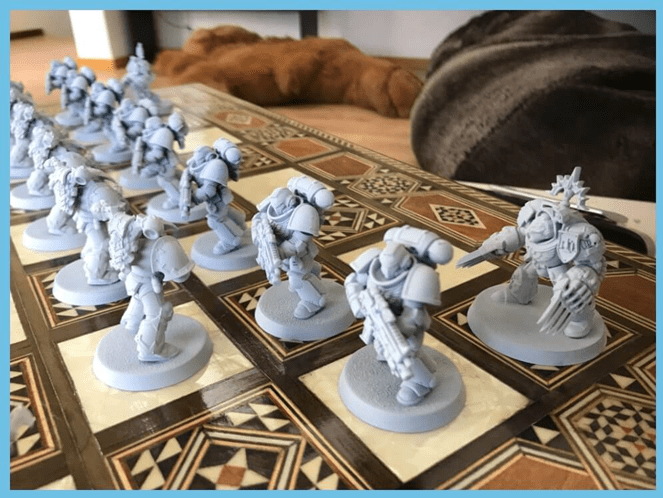
I’ve written two of these articles now, but the question remains, can you actually apply the same strategic principles to chess – a strategic two-player board game – that you can to Warhammer 40k – a strategic two-player board game…
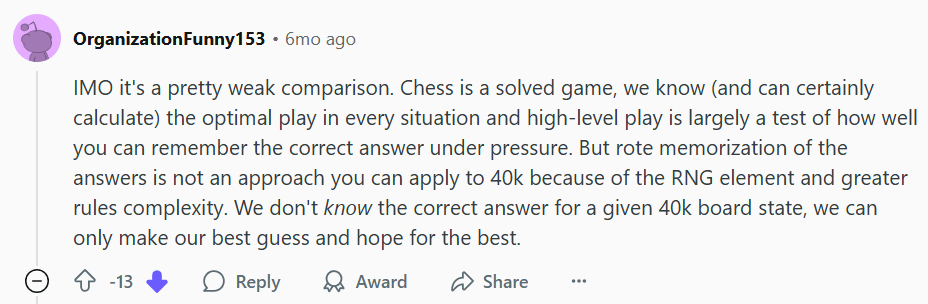
Don’t be like OrganizationFunny153.
NB. While there are always caveats to strategy depending on the game state, moves your opponents are making, and what army you are playing, these general chess principles can help advise strategy and thought processes during a game of Warhammer.
Winning and losing
You don’t win games by playing good moves: you lose them by playing bad ones.
Good moves and mistakes are inextricably linked. A good move may be needed to punish an opponent for a mistake, such as a risky charge allowing you to heroic intervention, or letting you overwatch with your bullshit balanced Infernal Master. A good move may even tempt a mistake; but good moves do not in themselves win games or create advantages. Good moves function to put the finger on mistakes that have already been made or create problems for your opponent that can lead to errors.
During a game of Warhammer, you can get tunnel visioned, and this can be surprisingly easy to forget. When your opponent devises a move that you have overlooked, or an idea that suddenly looks must stronger than you had previously thought it would be (i.e. because of a Strategem, did you know that the definition of a Strategem is: A clever scheme or tactic designed to achieve a specific objective, often involving deception or manipulation.), it is easy to sink into doom and gloom, assuming that your position is bad. At these moments, you need to remind yourself that you have not yet made any mistakes, so you cannot yet stand at any disadvantage. You simply have a problem to solve, so do about solving it.
There are caveats in Warhammer, as there are dice involved. You can feel incredibly foolish for letting your opponent get LoS on one of your units incidentally, until you pass all of your 4+ invulns, and your fears fade away.
Generally, it is a good idea to only pay attention to the position in front of you, and to not dwell on mistakes, how you got to the current position is irrelevant. The exception is to when you need to call the previous moves in evidence to acquit yourself of the charge of having made a mistake. Just because your opponent has made a good move, does not mean you’ve yet made a mistake.
Take your time, re-evaluate your thinking and position, and continue to make good moves.
Crime and punishment
You can win games by playing bad moves
But Ryan, you just said that you lose games by playing bad moves. Yea, what are you going to do about it?
You can win a game by playing ‘bad moves’ – meaning moves that offend or go against the normal principles – as the correct means of exploiting a previous error of the opponent.
Secondly, you can win a game of making objectively bad moves, when your opponent cannot bring themselves to make the necessary bad-looking moves in reply.
Is it a bad move to go for a 9″ charge out of Deepstrike.
Yes. You have a 27.8% chance of making a 9″ charge out of Deepstrike, or a 48.8% chance with a re-roll, or as one of the locals at my LGS would say, it’s about a 50/50.
While we should not want to encourage the deliberate playing of bad moves – which in Warhammer would be moves with a low % chance of being successful – it can often be true that dubious moves set the opponent more problems than correct ones.
In practice, this might mean moving within your opponent’s reasonable threat range but giving yourself a 10″ charge. As opposed to moving your unit within threat range for a 5-7″ charge in the next turn, while avoiding your opponent threat range (in this example your unit moves faster than theirs). If you end up being successful in your endeavour it is likely you have created more problems for your opponent, despite your play being a bad move.
Should you be making these moves? It depends.
Luck
Is there luck in Warhammer 40k? It depends on who you ask. There is a subset of gamers that like to pretend it’s a game of mostly skill, but we all know that there’s a good deal of luck in it too. If we really, fully understood what was going on throughout a game, and genuinely felt that we deserved full credit for all the opponent’s errors (because we only play good moves), then perhaps we could support the claim that skill is all that is involved. In reality, however, even the best players cannot control the game sufficiently not to be taken by surprise by unexpected occurrences.
When your steady pressure results in controlling board space, or a lead in victory points, and your opponent sacrifices a unit or makes a desperate play that works in their favour, it may be beyond the realm of calculation to know whether the advantage you had previously accrued is enough to win – especially when the secondaries you draw are absolute piss. If at the end of the game it turns out that you lost, you can justifiably consider that you were unlucky.
This is, however, one type of luck that is quite strongly within the control of the players. When a normally correct player commits a rare blunder, it is, of course, a piece of luck for his opponent – or when your dice roll like shit – but there are ways of ensuring that you have more than your fair share of lucky incidents.
Some players rarely give their opponents a chance to blunder.
Technically correct players in particular tend to avoid the sort of trappy moves that lead to opponents blundering. Blunders rarely come unprovoked. If possible, one should, without compromising one’s own position, leave a few things lying around that the opponent may trip over. You do not need to do anything so crude as setting traps. It is enough to believe that your opponent is capable of blundering to tip the scales of luck a little in your direction.
Cya nerds.
If you are interested, the lessons and strategies discussed in this article are taken from the book:
Improve your chess by William Hartston




 Litanies of the Faithful
Leave a comment